It took way too long for me to put this together, but here it is:
From my brew day this past weekend.
Note: At the end of the video, I meant to place an approximate length on secondary fermentation of 4 -6 weeks. Obviously, this is subject to change if you are brewing either a huge beer or a smaller session beer.
-HolzBrew
Monday, January 25, 2010

Sunday, January 10, 2010
Keep on Racking in the Free World

As pictured above, I took a gravity (a measure of the density of the liquid) reading before racking into secondary and noted it to be about 1.022 brix (a scale for measuring gravity). Hopefully when done this brew will have a final gravity around 1.015 coming down from a starting gravity of 1.066. Beers with higher final gravities will have a more noticeable sweetness relative to those with lower final gravities, due to the existence of unfermented or residual sugars. In my opinion, a good maibock should have a noticeable sweetness.
I was messing around with my new ipod nano, which now takes video (in case you've been living in a cave and didn't hear), and I took a quick video of the inside of the HolzBrew kegerator:
Surprisingly the video quality wasn't too bad for being on an mp3 player.
I hear that Northern Virginia is getting 22 ouncers of Troegs Nugget Nectar in this week, as well as, Bells Hopslam. Now that's a great week for beer. I've put an order in for a sixtel of Nugget Nectar, hopefully it all fits in the kegerator.
Keep it racking,
HolzBrew
Saturday, January 2, 2010
Temperature Control Woes
I love a full flavored and well made lager, but I hate making them myself. Over the years I've built fermentation chambers and used temperature override controls for freezers in order to achieve lager fermenting temperatures. All of which have been a pain in the butt (and a storage nightmare, considering we live in a small condo) and I've never quite been satisfied with any of the lagers I have brewed and I blame it on the difficulty of maintaining the proper temperature. I can brew ales, but a great lager has yet to roll out of the holzbrew kitchen.
Below the Maibock fermenting away three days in:

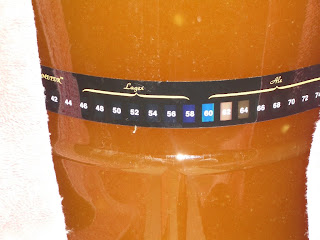
The first day I stored it in my kegerator at about 41 degrees F, but the fermentation was non existent. The second day I took the fermenter out of the kegerator and let it warm up slowly. All of day 2 it was fermenting in the 50 - 55 degree range and a nice fermentation was underway. Today as you can see it has warmed to about 60 degrees which is too high for a lager, I've placed it near the fireplace as that is a very drafty and cool area in our condo, but it seems to be maintaining a temp of about 60 (and it is bubbling away quite fiercely). I think I'll let it go here for at least a few more days in order to get the majority of the fermenting done and then move it into the kegerator for a week around 42 degrees and then drop the temps for 2 months closer to 34-35 degrees for lagering. Hopefully the lagering will help even out any off flavors from fermenting a little on the warm side.
Keep it cold,
HolzBrew
Below the Maibock fermenting away three days in:


The first day I stored it in my kegerator at about 41 degrees F, but the fermentation was non existent. The second day I took the fermenter out of the kegerator and let it warm up slowly. All of day 2 it was fermenting in the 50 - 55 degree range and a nice fermentation was underway. Today as you can see it has warmed to about 60 degrees which is too high for a lager, I've placed it near the fireplace as that is a very drafty and cool area in our condo, but it seems to be maintaining a temp of about 60 (and it is bubbling away quite fiercely). I think I'll let it go here for at least a few more days in order to get the majority of the fermenting done and then move it into the kegerator for a week around 42 degrees and then drop the temps for 2 months closer to 34-35 degrees for lagering. Hopefully the lagering will help even out any off flavors from fermenting a little on the warm side.
Keep it cold,
HolzBrew
Wednesday, December 30, 2009
Hella Cool
I stopped by MyLHBS yesterday to pick up some ingredients for a maibock. If you live in NOVA and homebrew you've probably heard of MyLHBS, it's a great little homebrew/winemaking supply store in the Seven Corners area run by guy named Derek. I asked Derek what yeast strain he recommended for a maibock and he fortunately had a few activators of the Wyeast Hella-Bock strain left. Apparently this is the same strain used by Ayinger. From Wyeast:
"Direct from the Austrian Alps, this strain will produce rich, full-bodied and malty beers with a complex flavor profile and great mouthfeel. Attenuates well while still leaving plenty of malt character and body."
Sounds pretty good, right? I am also using Hallertau and Saaz hops, pilsner malt, a little dextrin and crystal malt as well. The wort ended up with an OG of 1.066 and looks like:

Hella sweet,
HolzBrew
"Direct from the Austrian Alps, this strain will produce rich, full-bodied and malty beers with a complex flavor profile and great mouthfeel. Attenuates well while still leaving plenty of malt character and body."
Sounds pretty good, right? I am also using Hallertau and Saaz hops, pilsner malt, a little dextrin and crystal malt as well. The wort ended up with an OG of 1.066 and looks like:

Ah cloudy (the cloudiness should settle out during lagering) and golden deliciousness. The only real snafu I foresee is that the yeast's optimum fermenting temperature range is 48 - 56 degrees Fahrenheit, I am fermenting this in my kegerator and the temperature that I usually serve my beer at is right around 40 degrees, so I may have to come to some sort of compromise here. I am planning a 3 week primary fermentation followed by a two month lagering phase. I'll keep you updated on the progress.
Hella sweet,
HolzBrew
Sunday, December 27, 2009
Trouble in Paradise

In order to troubleshoot this problem I took the CO2 gas line and plug it into the out line (liquid line) and blasted it with CO2 for a minute. Foam erupted out of the "in" line, but it was easy enough to clean up.
At least temporarily this seems to have remove the blockage and restored the flow of brew.
Keep the kegs flowing,
HolzBrew
Sunday, December 20, 2009
Snowed In

Like a lot of people in the Mid-Atlantic we were more or less snowed in yesterday. It gave me sometime to keg the Hopsploitation. The ABV came in at 7.2%. I dry hopped the keg with a half ounce of Amarillo whole leaf hops. I've never tried that before, so I'm interested to see how fresh, the hop flavor is. So I officially have nothing fermenting in the house. Sounds like a problem I will have to remedy over the holiday break. I think I might brew a maibock for spring. Also, lately I have been infatuated with Duchesse De Bourgogne, so I like to possibly brew a flanders red. The fermentation time is at least a year, if not 18 months, so this one will require a lot of patience and a good resting spot in chateau de HolzBrew. Anyone have a good recipe?
I also had a bottle of Two Turtle Doves (by the Bruery) yesterday and I was blown away. It is definitely a monster dessert beer, brewed with cocoa nibs and toasted pecans, flavor country, to say the least.
Hope you stayed warm yesterday and your back is not aching too bad from all of the shoveling!
-HolzBrew
Wednesday, December 16, 2009
Perfect Holiday Beer: Old Ale

Sitting around this evening decorating the HolzBrew family Christmas tree and sipping on some Old Ale (North Coast Old Stock Ale). Sounds like a bad thing, right? Despite the name, Old Ale is a very very good thing. The perfect beer to enjoy this time of year sitting around the fireplace.
While not easy to define, because barleyewines and some winter warmers taste similar, old ale generally refers to darker english ales lowly attenuated so there are a high level of residual sugars. Per the name, these beers are typically fermented longer than the average english style ales. The alcohol levels can be anywhere from 7% to 10%.
During the early to mid 1800's brewing was big business in England. Porters and pale ales were being churned out at a quick pace. Typically fully fermented in just a few weeks. This was a change in business plan from brewers who were hoping to turn their inventory over faster. Naturally, it wasn't that easy. These beers with shorter fermentation tasted different. In order to get around public backlash (due to different tasting beer) brewers kept a smaller volume of beer around for a very long time, hence "old ale", and they would blend this beer with the fresh beer to achieve the flavor profile desired by their patrons.
By the 1850s - 60s, porter started to decline in popularity, so brewers started selling "Old Ale" directly to the pubs. These Old Ales sold to the public began to be brewed to their own unique recipes instead the Old Ale that was used for mixing. These beers were typically fermented for a year or more.
These Old ales had another unique quality, a noticeable acidic flavor. Around the year 1900 the yeast responsible for secondary fermentation (while the beer was being stored in casks, for aging) in old ales was identified in the Carlsberg laboratories in Denmark, and given the name Brettanomyces. Which is commonly found in Belgain ales.
Examples of classic english style old ales are Theakston Old Peculier and Thomas Hardy's Ale. Some of my favorite American takes on this style include North Coast Old Stock Ale, Great Divide Hibernation Ale, and Southern Tier Old Man Winter Ale.
Sometimes older is better,
HolzBrew
Subscribe to:
Posts (Atom)