I don't really have time to formulate a witty and intriging post, but I thought I'd let everyone know what's up in the HolzBrew homebrew world. I brewed a Imperial Belgian Wit (the OG was 1.066, does this really qualify as Imperial? I say yes), this weekend that I am pretty jazzed about. The plan is once it gets through primary fermentation to add some french oak cubes that have been soaking in Gran Marnier, and most likely I'll add some additional Gran Marnier as well. I'm looking to accentuate the orange flavor in a Belgian Wit.
I also bottled the maibock I brewed back in December. Its really turned out well and I'm pretty sure I am going to enter it into the upcoming national homebrew competition . I am considering entering my holiday ale (tripel) as well as the Old Woodie Ale (specialty wood aged beer). This would be the first competition I've ever entered my beers in and certainly some of the steepest competition. Regardless of winning any awards I think it would be cool to get back some constructive criticism.
That's it for now.
-HolzBrew
Tuesday, March 16, 2010

Thursday, March 4, 2010
10 Questions for a Sweet Brewer
It's been a few weeks since the last post, largely due to a busy work schedule. It's not like I stopped drinking beer, don't worry. I haven't had time in the last month to brew anything, but I've got some ideas kicking around. A few weeks back I had sent out some questions to Nick Funnell, the head brewer at Sweetwater Tavern. He was nice enough to get back to me. In case you haven't been there Sweetwater Tavern operates three locations in Northern Virginia: Merrifield, Centreville, and Sterling. It's one of the best restuarants near me in the Merrifield area, with a great food selection ranging from steak and fish to more casual offerings like sandwiches and salads (think Outback Steakhouse, but with good food and service). Also, the beer is made in-house and pretty darn good to boot. Nick has amassed some hardware from the Great American Brewfest over the years and it shows. Here goes:
Holz: First, can you give my readers an idea of how you got started in brewing? Were you originally a homebrewer?
Nick: I got started in brewing after getting a degree in Chemistry and finding an apprenticeship in a brewery. I have only ever homebrewed once, without distinction.
Holz: Did you attend any school to study brewing or did you start right out working at a brewery?
Nick: I studied brewing as part of my apprenticeship.
Holz: Sweetwater Tavern always has a nice selection of year round and seasonal offerings, how do you approach the creative process of crafting a new brew?
Nick: When we create a new beer we look for a gap in our portfolio that needs filling.
Holz: I believe Great American Restuarants (owner of Sweetwater Tavern) won two medals this year at the Great American Beer Fest, congratulations. Which beers won?
Nick: We won a Bronze medal in the Belgian Wit bier category for Wits’ End and a Gold in the Rye beer category for Crazy Jackass Ale.
Holz: Were you able to make it out to Denver this year for the festival?
Nick: I was lucky enough to be in Denver for the festival.
Holz: Occassionally, I see Great American beers available at the store, do you guys bottle your beers? Any plans to ramp up bottling production?
Nick: We do not bottle any beer for stores. We concentrate our efforts on getting people to come to us where we are able to fully guarantee the flavor and freshness of our beer. We do sell growlers of beer to go and they are filled on a counter pressure machine that ensures quality.
Holz: Which breweries and/or brewpubs inspire you?
Nick: Almost all breweries and brewpubs inspire me as there is something to be learned from each one.
Holz: Besides drinking the final product, what do you enjoy most about brewing?
Nick: The satisfaction of producing a great product that has developed a passionate following.
Holz: Which beer style do you enjoy brewing/drinking the most? The least?
Nick: All beers are equally satisfying to make as the process is essentially similar. As a brewer it is important to not favor one style over another when it comes to making the beer, or some will be better made than others. That wouldn’t be fair to the drinkers.
Holz: Is there any Sweetwater Tavern news (major or minor) that you want to share with my readers? New beers, locations, etc.?
Nick: Keep checking the website to see what we are up to.
Eat and Drink at Sweetwater. It is so ordered.
-HolzBrew
Saturday, February 13, 2010
Aging Beer

You are staring at 4 years (2007-2010) of Sierra's Bigfoot Ale, a delicious American barleywine which comes out this time of year. To the uninformed, the thought of "old beer" is probably a turnoff. To the beeradvocate, properly aged (or vintage) brew can be a real treat.
Most people think that wine is the only fermented drink that should be be aged, not true. Various styles of beer benefit from aging as well. Now this isn't for all types of beer. Your typical brew only has a shelf life of about 4-5 months, before it starts to noticeably degrade. The type of beer that may benefit from aging are your big beer styles like barleywines, strong ales, imperial stouts, Belgian strong ales, old ales and etc. Aging can add a whole lot of complexity to a beer like this. A general rule of thumb is beers over 8% are good candidates for aging.
Starting to age or cellar beer is easy enough. The toughest part is the patience required. If you've got a beer you love sitting around it's real easy to pop the top and quaff that delicious brew. Make sure to buy at least two of every beer you plan to age. You'll want to try one immediately in order to have a baseline in which to compare the aged version. The "second" or remaining beer should be aged for at least a year, but sometimes for several years (some beers can be aged for 15-20 years).
Where the heck do I store this stuff? Most importantly the beer should never come into contact with heat or light. Both will punk your delicately aging hooch. Beer that is allowed to sit in direct sunlight for too long (more than a few minutes) will develop a skunky flavor. You should store your beer in a cool area, away from direct light. Ideally you should store this aging brew at a constant 50 - 60 degrees.
That being said for most people it'll be near impossible to store at those temperatures unless you've got a temperature controlled room in your house. For many people a dark and cool basement is the most practical and best environment in which to age beer.
Counter intuitively, long-term refrigerator use is not ideal. Refrigerators are designed to keep food dry, so dehydration of cork or cap can become an issue (laid-down or upright), allowing the beer to become oxidized.
Now that you know how to cellar, what should you expect a year or more from starting to age your stash. Honestly, no one knows for sure. There are lots of variables that come to play. Some beers age exceptionally well, others don't. One word of advice, big beers like double IPA's that showcase a large hop presence, usually don't get better with age. The hop characteristic tends to degrade quickly with age.
Age some beer,
HolzBrew
Saturday, February 6, 2010
Blizzard 2010
Not exactly beer related, but I put together some footage from the blizzard today. I also arranged the instrumental track for the video.
I hope everyone stayed safe.
-HolzBrew
I hope everyone stayed safe.
-HolzBrew
Monday, January 25, 2010
How to Brew Beer in 3 Minutes
It took way too long for me to put this together, but here it is:
From my brew day this past weekend.
Note: At the end of the video, I meant to place an approximate length on secondary fermentation of 4 -6 weeks. Obviously, this is subject to change if you are brewing either a huge beer or a smaller session beer.
-HolzBrew
From my brew day this past weekend.
Note: At the end of the video, I meant to place an approximate length on secondary fermentation of 4 -6 weeks. Obviously, this is subject to change if you are brewing either a huge beer or a smaller session beer.
-HolzBrew
Sunday, January 10, 2010
Keep on Racking in the Free World

As pictured above, I took a gravity (a measure of the density of the liquid) reading before racking into secondary and noted it to be about 1.022 brix (a scale for measuring gravity). Hopefully when done this brew will have a final gravity around 1.015 coming down from a starting gravity of 1.066. Beers with higher final gravities will have a more noticeable sweetness relative to those with lower final gravities, due to the existence of unfermented or residual sugars. In my opinion, a good maibock should have a noticeable sweetness.
I was messing around with my new ipod nano, which now takes video (in case you've been living in a cave and didn't hear), and I took a quick video of the inside of the HolzBrew kegerator:
Surprisingly the video quality wasn't too bad for being on an mp3 player.
I hear that Northern Virginia is getting 22 ouncers of Troegs Nugget Nectar in this week, as well as, Bells Hopslam. Now that's a great week for beer. I've put an order in for a sixtel of Nugget Nectar, hopefully it all fits in the kegerator.
Keep it racking,
HolzBrew
Saturday, January 2, 2010
Temperature Control Woes
I love a full flavored and well made lager, but I hate making them myself. Over the years I've built fermentation chambers and used temperature override controls for freezers in order to achieve lager fermenting temperatures. All of which have been a pain in the butt (and a storage nightmare, considering we live in a small condo) and I've never quite been satisfied with any of the lagers I have brewed and I blame it on the difficulty of maintaining the proper temperature. I can brew ales, but a great lager has yet to roll out of the holzbrew kitchen.
Below the Maibock fermenting away three days in:

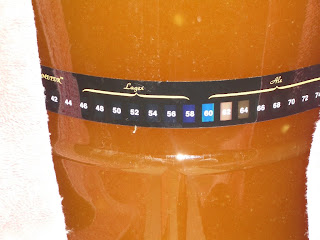
The first day I stored it in my kegerator at about 41 degrees F, but the fermentation was non existent. The second day I took the fermenter out of the kegerator and let it warm up slowly. All of day 2 it was fermenting in the 50 - 55 degree range and a nice fermentation was underway. Today as you can see it has warmed to about 60 degrees which is too high for a lager, I've placed it near the fireplace as that is a very drafty and cool area in our condo, but it seems to be maintaining a temp of about 60 (and it is bubbling away quite fiercely). I think I'll let it go here for at least a few more days in order to get the majority of the fermenting done and then move it into the kegerator for a week around 42 degrees and then drop the temps for 2 months closer to 34-35 degrees for lagering. Hopefully the lagering will help even out any off flavors from fermenting a little on the warm side.
Keep it cold,
HolzBrew
Below the Maibock fermenting away three days in:


The first day I stored it in my kegerator at about 41 degrees F, but the fermentation was non existent. The second day I took the fermenter out of the kegerator and let it warm up slowly. All of day 2 it was fermenting in the 50 - 55 degree range and a nice fermentation was underway. Today as you can see it has warmed to about 60 degrees which is too high for a lager, I've placed it near the fireplace as that is a very drafty and cool area in our condo, but it seems to be maintaining a temp of about 60 (and it is bubbling away quite fiercely). I think I'll let it go here for at least a few more days in order to get the majority of the fermenting done and then move it into the kegerator for a week around 42 degrees and then drop the temps for 2 months closer to 34-35 degrees for lagering. Hopefully the lagering will help even out any off flavors from fermenting a little on the warm side.
Keep it cold,
HolzBrew
Subscribe to:
Posts (Atom)